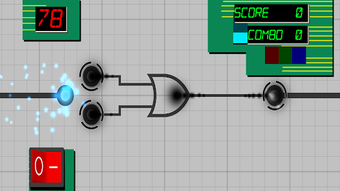
Fast-paced circuit puzzles that teach basic Boolean logic
Gate Runner: Digital Logic, by masakaz, is an Android puzzle game that teaches Boolean circuitry through timed, arcade-style runs. Players route moving signals through branching circuits in real time, choosing outputs at logic nodes to reach goals. The app pairs an interactive gate simulator with a minimalist, learn-through-play presentation that encourages experimentation. It targets puzzle fans, CS and EE students, and anyone wanting compact practice with fundamental Boolean concepts.
What kind of game is Gate Runner?
This is an educational, arcade-flavored puzzle runner in which the core loop asks you to direct a flowing signal through branching circuitry. Success depends on quick choices at junctions, pattern recognition of gate behavior, and maintaining accuracy under a ticking clock. The format treats each circuit as a short, self-contained challenge, so play sessions can be brisk while still exercising logical reasoning.
Does it teach digital logic through play?
The standout teaching method is its learn-through-play design. Rather than long manuals, the game teaches Boolean concepts by placing gates in active puzzles. It simulates standard digital gates and lets players discover behaviors by trial. Key gate types included are:
- AND
- OR
- NOT
- NAND
- NOR
- XOR
What does the game look and sound like?
The presentation is intentionally minimalist and leans on an arcade aesthetic, keeping visuals focused on gate symbols and moving signals so you can see state changes at a glance. Time pressure is explicit, with puzzles played against a countdown that creates urgency. Touch controls on Android map to simple taps or swipes to redirect signals, keeping interaction lightweight and focused on decision speed.
Is it hard to get started?
Onboarding relies on experimentation rather than guided tutorials, so beginners must learn by testing gate outcomes in short runs. Difficulty ramps through progressive levels, with circuits becoming more complex as you advance. Players comfortable exploring and iterating find steady improvement; those who prefer explicit, step-by-step instruction face a steeper initial learning curve until patterns become familiar.
Who should settle into this title?
This game is a welcoming pick for players who enjoy compact, active problem-solving and steady skill practice; it rewards curiosity and repeated short sessions. Players seeking structured, explicit instruction may find the looser, discovery-driven approach less comfortable. For learners and puzzle enthusiasts who like hands-on experiments in small doses, the game is an engaging way to sharpen circuit reasoning.